Does the Tesla key card need a Faraday wallet?
Yes. The Tesla key card is a passive NFC device — it broadcasts when energized by a reader, not continuously. That means a casual relay attack against an idle card is harder than against a traditional key fob, but a hostile NFC reader within ~10 cm can still trigger the card. More importantly, in normal carry (pocket, wallet next to phone) the card is regularly close to active NFC sources. Faraday isolation when not in active use eliminates the attack window.
Is the Tesla phone key safer than the key card?
No — different attack surface, not a smaller one. The Tesla phone key uses Bluetooth Low Energy (BLE) to authenticate continuously when the phone is near the vehicle. BLE relay attacks against Tesla phone keys have been demonstrated publicly multiple times since 2022. The attacker uses two paired BLE relay devices: one near the principal's phone, one near the Tesla. The car authenticates to the relay device next to it as if the principal's phone were present. Faraday-shielding the phone when not in active driving use is the defense.
What about Tesla's PIN-to-Drive feature?
PIN-to-Drive is excellent for unauthorized-driving prevention but does not prevent unlock and entry — the relay attack still gets the thief into the car. Once inside, the attacker has access to whatever is in the cabin (laptops, documents, garage opener, registration with home address). PIN-to-Drive plus Faraday-shielded carry of the key card and phone key together solve the complete threat: relay attack cannot complete the unlock, and even if it could, the drive does not start.
Does the Tesla key fob (not card or phone) need Faraday too?
Yes — and it has the standard relay-attack vulnerability that all proximity-broadcasting fobs have. The Tesla key fob (sold separately for Model S/X owners who prefer it over the card) broadcasts on 315 MHz / 433 MHz like other modern fobs. Relay attacks work the same way they do against
Range Rovers, BMWs, and Mercedes. Same Faraday solution, same protocol.
Is valet mode enough to skip the Faraday wallet?
No. Valet mode limits cabin access (glovebox locked), restricts speed and acceleration, and disables the homelink — all useful for valet attendants. It does not change the unlock/start authentication. The relay-attack vector is the same whether the car is in valet mode or not. Faraday isolation of the key card and phone key when not in active use is the only protection that addresses the unlock vector itself.
Which Faraday solution works for both the key card and the phone key?
The REVIS-1
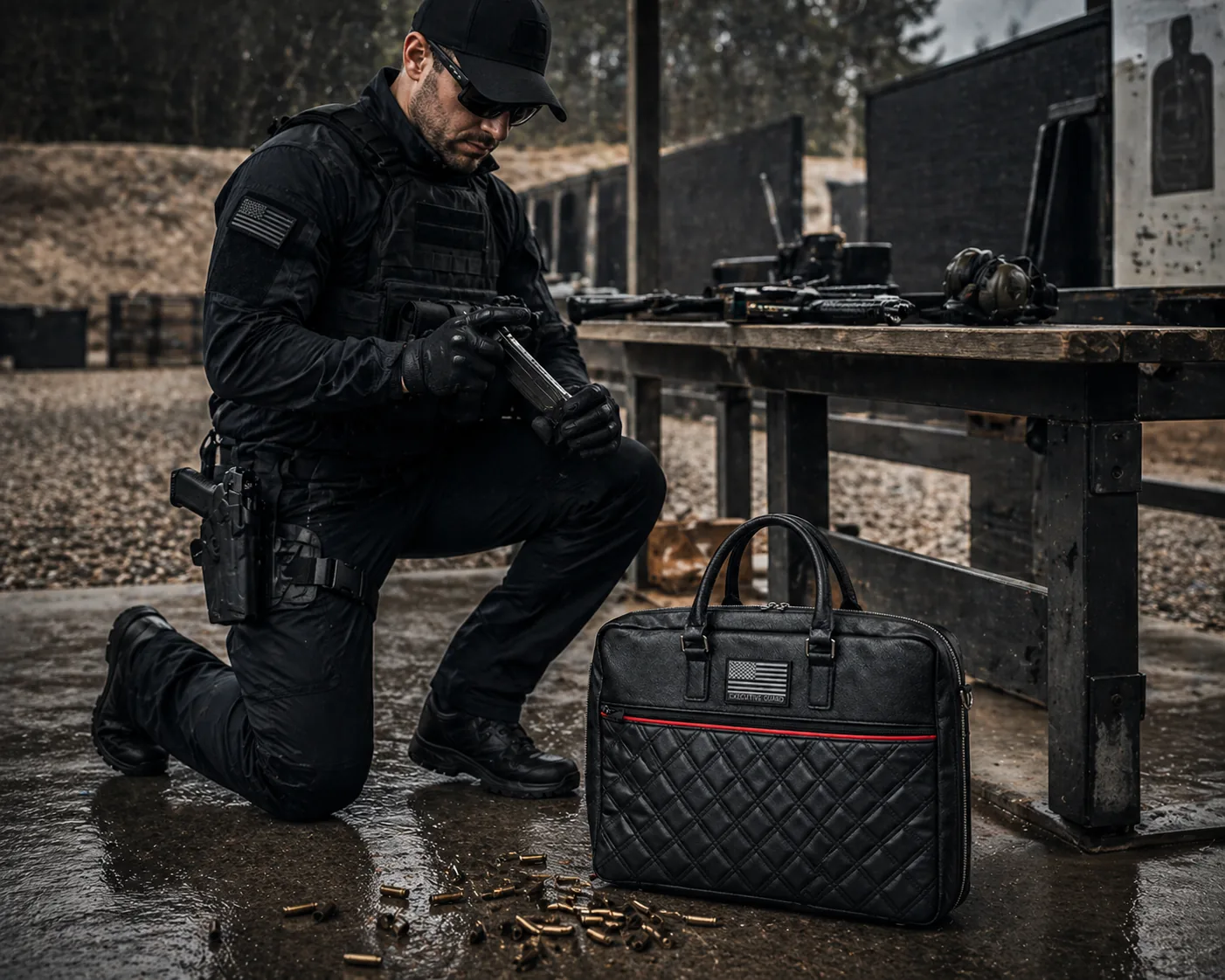
Executive Guard. Three independent Faraday-shielded chambers in one chassis: laptop, tablet+phone, and wallet+keys+RFID. The wallet+keys chamber holds the Tesla key card alongside other RFID credentials. The tablet+phone chamber holds the phone key when not actively driving (overnight, in meetings, in the hotel room, at the conference). One bag, both attack surfaces, no separate accessories. $280.