Theft Briefing · April 2026

Range Rover keyless theft: why it's #1, and how to stop it.

Range Rover and Land Rover are the most-stolen luxury vehicles in both the U.S. and U.K. by absolute numbers. Insurance industry data, the structural reasons it keeps happening, JLR's 2024 firmware response, and the only physical defense that works on every model from 2014 through current production.

Published April 30, 2026 Updated April 30, 2026 Reading time 9 min Vehicles covered 5 lines
The Short Answer

Range Rover is #1 for three reasons. One defense beats all three.

Range Rover and Land Rover are the most-stolen luxury vehicles in the U.S. and U.K. because of high export-market resale value, predictable smart-key implementation across the entire JLR lineup, and a buyer demographic that often parks in driveways visible from the street. JLR's 2024 firmware update raised the bar but did not eliminate the attack class. The only defense that works on every model, every firmware version, every equipment generation is Faraday storage of the key fob — physically blocking the LF wake-up signal that relay-attack thieves amplify between car and house.

This article covers the insurance data, the attack methodology, the brand-specific reasons Range Rover sits at the top of the theft tables, and the practical workflow for daily Faraday-storage that owners actually use.

The Numbers

Why insurance underwriters know this brand by heart.

Specific 2024–2025 figures from U.K. and U.S. insurance data:

#1
Most-stolen luxury vehicle (UK)
~30s
Time to complete relay attack
$200
Cost of relay equipment
$70k+
Average loss per claim

Range Rover-line policies are now among the most expensive comprehensive premiums in the U.K. and increasingly in the U.S. Some U.K. underwriters have refused new Range Rover Sport and Range Rover SVR policies entirely outside of policies with documented Faraday-storage clauses and tracker installation. NFU Mutual reported in 2024 that Range Rover claims accounted for roughly 35% of their high-value-vehicle theft payouts despite Range Rover representing under 10% of policies in that price band.

The macro picture: as smart-key vehicles age out of warranty into the secondary market, the original-owner population shifts to people without dealer-network relationships and without organized fleet-protection programs. The thieves know this. Targeting concentrates on the well-known vulnerable population.

The Three Structural Reasons

Why this vehicle. Why this brand. Why every year.

1. Export-market resale value

A stolen Range Rover Sport in working order is worth $25,000–$45,000 on the West African export market in 2024 numbers, $30,000–$60,000 in Eastern Europe, and similar in the Middle East. The chop-shop value (parts) is also high — engines, transmissions, electronic control units, body panels all in demand for legitimate JLR-dealer parts replacement plus the parallel grey-market repair industry. This makes Range Rover a uniquely high-margin theft target.

Compare to a stolen Tesla Model 3, where the export-market resale value is much lower (the vehicle requires Tesla cloud-services authentication that does not transfer cleanly outside North America) and the chop-shop value is constrained by Tesla's vertical integration of parts. The economics push thieves toward Range Rover.

2. Predictable smart-key implementation

Pre-2024 Range Rover, Range Rover Sport, Velar, Discovery, and Defender models all share the same underlying smart-key implementation at 315/433 MHz LF. Attack equipment built for one model works across the entire JLR lineup with minimal tuning. This means a single relay-attack rig can attack every JLR vehicle on a residential street in a single night.

Compare to Tesla, where the rolling-code implementation is more frequently updated via OTA software releases, or BMW, where the implementation varies more across the M-line, X-line, and i-line. The single-implementation-across-fleet aspect of JLR is what made Range Rover the highest-ROI target.

3. Buyer demographic and parking patterns

Range Rover buyers concentrate in suburban and rural-residential demographics that often park in open driveways visible from the street. The thieves can scout targets at night by simply walking the street looking for the silhouette. Compare to apartment-building or gated-community parking, which adds friction even before the fob attack starts.

Combined with the high probability that the standard fob is sitting in a bowl by the front door (because the front door is feet from the parked vehicle), this makes Range Rover the textbook relay-attack target.

2024 Firmware Update

What JLR did. Why it isn't enough.

Jaguar Land Rover responded to the public scrutiny in 2024 with a major over-the-air firmware update that introduced two changes:

Tighter rolling-code timing windows

The legitimate fob-to-car authentication now happens within a much shorter time window than the 2020-era implementation allowed. Older relay-attack equipment (built around the longer windows) could not keep up — the relay would time out before the authentication completed.

UWB ranging on supported model years

Range Rover, Range Rover Sport, and Defender model years 2024+ added Ultra-Wideband ranging on top of LF. UWB allows the car to verify the fob is physically within a few feet rather than just within radio range. The car can refuse to unlock if the timing of the response suggests the fob is being relayed from a distance.

Why the attack class is not eliminated

Three reasons. First — pre-2024 model years (2014–2023, the largest part of the in-service fleet) do not get UWB ranging via firmware update; the hardware is not present. Those vehicles only get the timing-window tightening, which can be defeated by faster relay equipment. Second — relay-attack equipment circulating in 2025–2026 has caught up to the patched timing. The criminal supply chain adapts; the firmware does not get re-updated as fast. Third — UWB-equipped 2024+ vehicles can still be attacked when the fob is physically close to a window or door (the UWB ranging cannot tell whether the fob is in your hand or three feet away through a wall in a thief's amplifier).

Faraday storage is the only defense that works regardless of firmware version, equipment generation, or vehicle model year. If the fob's signal cannot leave the bag, no firmware patch and no UWB ranging matter — the attack does not get to the radio layer.

The JLR Lineup

Vulnerability across the brand.

Model LineYears AffectedLF FrequencyUWB?Risk Profile
Range Rover (full-size)2014 – current315 / 433 MHz2024+ onlyVery High
Range Rover Sport2014 – current315 / 433 MHz2024+ onlyVery High
Range Rover Velar2017 – current315 / 433 MHzNoHigh
Land Rover Discovery (5)2017 – current315 / 433 MHzNoHigh
Land Rover Discovery Sport2014 – current315 / 433 MHzNoHigh
Defender (L663)2020 – current315 / 433 MHz2024+ onlyHigh
Range Rover Evoque2014 – current315 / 433 MHzNoModerate

Risk profile is a function of resale value × theft-equipment compatibility × buyer demographic. Every model in the lineup is technically vulnerable; the higher-tier models (Range Rover full-size, Sport) are simply more attractive theft targets for crews with the equipment.

Daily Workflow

How Range Rover owners actually use a Faraday bag.

The key insight is that Faraday storage has to be effortless or owners stop doing it within the first month. Here is the workflow that 70%+ of repeat Range Rover-owner buyers describe:

The evening drop

Walk through the door from the garage or driveway. Drop the standard Range Rover fob into the REVIS-1 (chamber 3 — wallet+keys). Drop the iPhone into chamber 2. Drop the laptop into chamber 1 if you brought it home. Bag stays at the entryway on a side table or shelf.

The relay-attack thieves arrive at 3 a.m., deploy the amplifier at the front door — and the LF signal does not leave the bag. The amplifier has nothing to relay. The attack cannot complete. The vehicle stays where you parked it.

The morning routine

Morning, open chamber 3, take the fob, drive to work normally. Smart-key UX is fully preserved. The bag stays at home for the day, ready for the evening drop. No friction added to your daily routine — the friction is added to the thief's routine, which is exactly the right place for it.

The travel routine

Business travel. Bag is the briefcase. Fob plus phone plus laptop plus wallet all silenced for the duration of the airport, hotel, conference, customs, hotel-room storage. Returns to the evening-drop pattern when you get home. Same bag, same workflow.

The Bag Range Rover Owners Buy

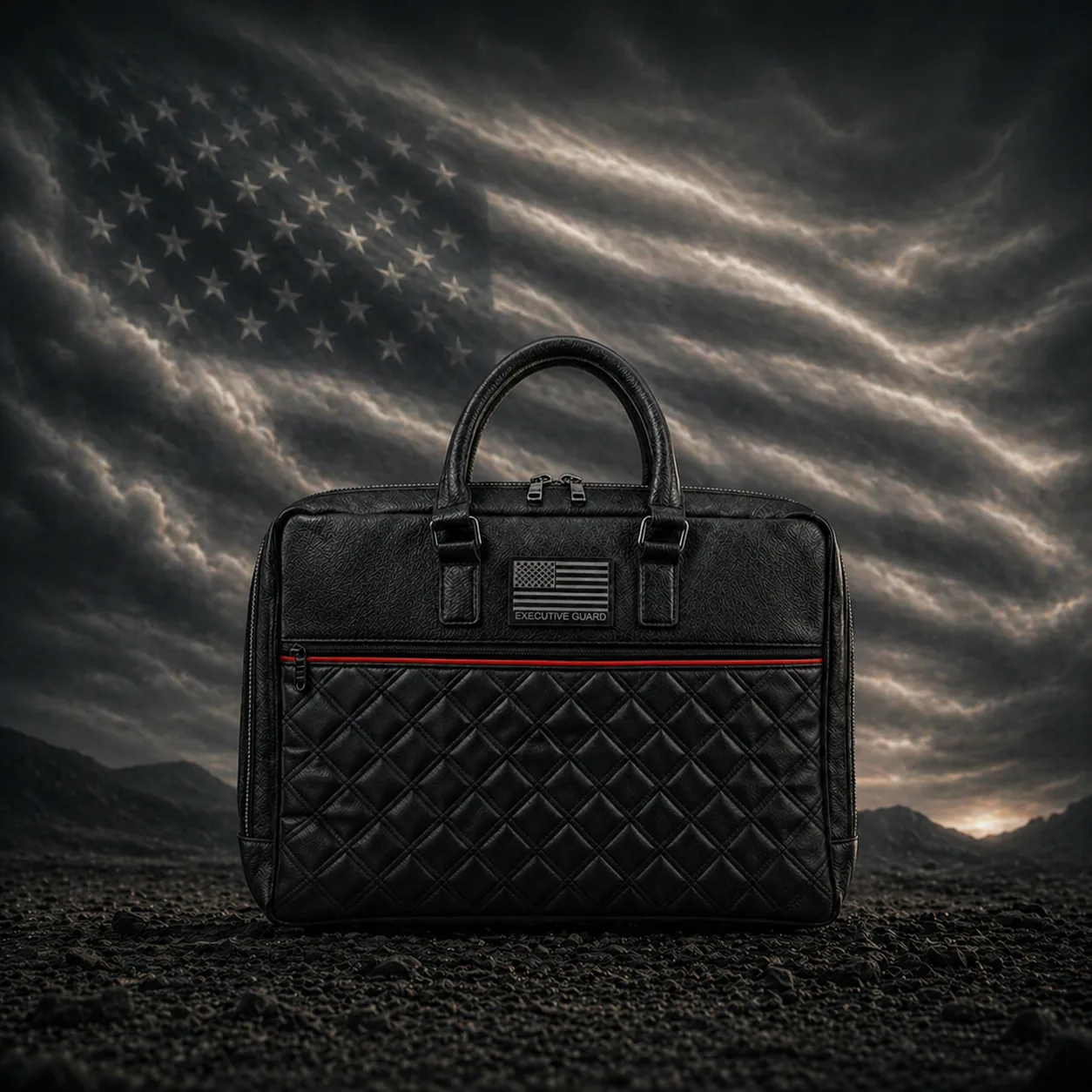
The REVIS-1 Executive Guard handles the fob plus everything else.

Three independently shielded chambers. 76–85 dB attenuation across 30 MHz – 10 GHz. Verified against Range Rover, Range Rover Sport, Defender, Discovery, and Velar smart-key frequencies. Made in the United States. $129 with free U.S. shipping and 30-day money-back guarantee. The same buyer demographic that buys Range Rover is the buyer demographic this bag is designed for.

Acquire — $129 Read the Pillar Brief
FAQ

Range Rover-specific questions.

Why is Range Rover the most-stolen luxury vehicle?
Three structural reasons. First — high resale value in export markets (West Africa, Eastern Europe, Middle East) means a stolen Range Rover is worth more on the chop-shop or container-export market than most luxury equivalents. Second — predictable smart-key implementation that pre-2024 models share across the entire Range Rover, Range Rover Sport, Velar, Discovery, and Defender lineup, making attack equipment scale across the brand. Third — the vehicle is owned by a demographic (HNW principals, family-office staff, dealer fleet customers) that often parks in driveways visible from the street, making target identification trivial for theft crews scouting at night.
Did JLR fix the keyless theft problem with the 2024 firmware update?
Partially. JLR's 2024 over-the-air update added timing-window tightening and rolling-code refinements that defeat older relay-attack equipment. New equipment circulating in 2025–2026 has caught up to the patched timing windows. The update is worth applying — it raises the bar — but it does not eliminate the attack class. Faraday storage of the fob remains the only defense that works regardless of firmware version, equipment generation, or vehicle model year.
Will my Range Rover insurance still cover relay-attack theft?
Most comprehensive policies do — but the 2024–2026 trend across major U.K. insurers (Admiral, Direct Line, NFU Mutual, AXA) and increasingly U.S. insurers covering Range Rover policies is conditional coverage. Some policies now ask whether the keys were stored in a Faraday-shielded container at the time of the theft. A 'no' answer can result in claim reduction or denial. Document your storage method (photo of the fob in a Faraday bag, dated) and keep it with your policy paperwork.
Which Range Rover models are most vulnerable to relay attacks?
All keyless-equipped Range Rover, Range Rover Sport, Velar, Discovery, and Defender models from 2014 through current production are vulnerable to relay attacks unless the owner has applied the 2024+ firmware update AND uses Faraday storage. Pre-2014 models with mechanical keys are not affected by relay attacks (different attack vectors apply). The Range Rover Activity Key (the wristband variant) does not solve the problem because the standard fob also remains active in the household.
Can a Faraday bag stop a Range Rover relay attack?
Yes — and it is the only physical defense that works universally. Range Rover smart keys transmit on the LF band at 315 / 433 MHz. A Faraday bag rated for the full 30 MHz – 10 GHz envelope (such as the REVIS-1 Executive Guard at 76–85 dB attenuation) blocks the signal completely. With the fob inside the bag, the relay-attack amplifier has no signal to capture, no signal to relay, and no signal to extend to the vehicle. The attack cannot complete.
What about the Range Rover Activity Key (wristband)?
The Activity Key is an alternative fob in a wristband form factor designed for active use (running, swimming, gym). It does not replace the standard fob — both remain active in the household. Relay-attack thieves target the standard fob because it is always present in the home; the Activity Key is irrelevant to their attack. Some owners assume the Activity Key is a security feature; it is not. Faraday storage of the standard fob is what stops the attack.
Are there Range Rover-specific Faraday products?
The Faraday product category is generic across vehicle brands — any quality Faraday bag rated for the LF wake-up frequencies blocks every smart-key brand including Range Rover. The differentiator is form factor and total threat coverage. The REVIS-1 Executive Guard is a structured executive briefcase that handles the fob plus everything else an HNW principal carries (laptop, phone, tablet, wallet, RFID credentials) — the same buyer demographic that drives Range Rover sales in the first place.
How quickly can a Range Rover be stolen with a relay attack?
Under 30 seconds, end to end. CCTV footage of relay-attack thefts on Range Rovers shows the entire sequence: vehicle approach (15s), amplifier deployment at front door + handle pull at car (10s), door unlocked + engine started + vehicle driven away (15s). No window broken, no alarm tripped. Most owners do not realize the vehicle is gone until the next morning. By then it is in a chop shop or on a container ship to the export market.