Surveillance Briefing · April 2026

IMSI catchers & Stingrays: protection that actually works.

Cell-site simulators force phones onto fake cellular towers and harvest call metadata, SMS, and location. Used legally by U.S. federal and state law enforcement, and illegally by foreign intelligence near hotels, embassies, and conferences. Software detection is unreliable. Faraday isolation is the only physical defense that defeats every variant — modern, legacy, and 5G-capable.

Published April 30, 2026 Updated April 30, 2026 Reading time 9 min Threat profiles 5
The Short Answer

The phone has to be off the network. Faraday gets it there.

An IMSI catcher (often called a Stingray after the Harris Corporation product line) is a portable cell-site simulator that mimics a legitimate cellular tower. Phones in range are tricked into connecting to it instead of a real tower. Once connected, the operator harvests the phone's IMSI, call metadata, SMS content, and approximate location. Faraday isolation defeats this attack class entirely — inside a quality Faraday bag, the phone has no cellular signal at all, so the simulator has nothing to attach to. The attack cannot complete because the phone is not on any cellular network.

Software detection (apps like SnoopSnitch, AIMSICD) is unreliable against modern equipment. Airplane Mode works at the OS level but depends on the phone's implementation being trustworthy — for high-stakes threat models, that assumption is shaky. Faraday isolation is mathematically guaranteed regardless of OS state, firmware version, or simulator generation.

How They Work

The cellular protocol vulnerability that has not been fixed in 30 years.

Cellular protocols (2G, 3G, LTE, 5G) all begin with a tower-authentication exchange. The phone tells nearby towers its IMSI; the tower with the strongest signal wins; the phone connects to that tower. The protocol does not require the phone to verify the tower is genuine — only the tower verifies the phone. This asymmetric trust model dates from the 1980s when the threat of fake towers was theoretical and protocol designers prioritized simplicity.

The IMSI capture

The simulator broadcasts a stronger signal than nearby legitimate towers in a target area (a hotel lobby, a financial-conference venue, a courthouse, a foreign embassy area). Phones in range automatically connect to the simulator instead of legitimate towers. The simulator captures every IMSI as the phones attempt to register. For a passive operator, this alone identifies who is in the area and at what time.

The downgrade attack

Once connected, the simulator can force the phone to downgrade from LTE or 5G to 2G — which has weaker authentication and was deprecated in most U.S. networks but remains supported on phones for legacy compatibility. On 2G, the operator can intercept SMS in plaintext, capture call metadata, and in some configurations relay the phone to a legitimate network while sitting in the middle (man-in-the-middle).

The location triangulation

Multiple simulators in coordinated deployment can triangulate a target's location to within meters. Some operations use mobile simulators (vehicle-mounted) to track a phone's movement through a city. Others use fixed deployments at chokepoints (airport terminals, courthouse approaches) to identify who passes through.

Why 5G doesn't fully solve it

5G includes encrypted IMSI exchange that defeats simple legacy simulators. But NR-mode Stingrays (5G-capable) have been available since 2022 and bypass the new protections. Additionally, the simulator can force a 5G phone to downgrade to LTE or 3G, which still leak. The protocol weakness is structural; protocol upgrades raise the bar but do not close the attack class.

Capability Reference

What an IMSI catcher actually captures.

Data TypeCaptured?Effort Required
IMSI (subscriber identity)CapturedTrivial · passive collection
IMEI (device identity)CapturedTrivial · passive collection
Approximate locationCapturedTrivial · passive collection
Call metadata (who/when/duration)CapturedActive · downgrade or MITM mode
SMS content (plaintext on 2G)CapturedActive · downgrade attack to 2G
Voice calls (plaintext on 2G)CapturedActive · downgrade + relay
iMessage / Signal / WhatsApp contentNot capturedEncrypted at app layer · simulator only sees metadata
Web traffic contentNot capturedHTTPS encrypted · simulator only sees metadata
Email contentNot capturedTLS encrypted · simulator only sees metadata
Bank app activityNot capturedCert-pinned TLS · simulator only sees connection metadata

The takeaway: IMSI catchers are a metadata harvester, not a content harvester for modern encrypted apps. The metadata still has serious operational value — who you talk to, when, where, for how long — even when the content of the conversation remains encrypted. For pattern-of-life surveillance, financial-investigation correlation, or M&A-leak detection, the metadata is often sufficient.

Who Should Care

Five professional profiles where the threat is documented.

Investigative journalists

National-security, financial-investigation, organized-crime beats. Source protection is the entire job. IMSI metadata reveals which sources you contact and when — even if the content stays encrypted.

M&A counsel

Material non-public information on transit between client offices. A pre-announcement leak destroys deal value before signing. State-actor and counterparty surveillance documented in multiple deal investigations.

Diplomats & embassy staff

Foreign intelligence operates IMSI catchers near U.S. embassies abroad and near foreign embassies in U.S. cities. Documented State Department guidance for outbound diplomatic travel includes IMSI countermeasures.

Activists & dissidents

Diaspora populations from countries with active intelligence operations against their members in the U.S. Several documented cases involve IMSI catchers operated near community centers and political events.

C-suite executives

M&A targets, companies with material non-public information, defense contractors, biotech IP holders. Corporate-espionage operators have access to commercial IMSI equipment from the gray-market resale chain.

What Defends Against IMSI Catchers

Three approaches, ranked by reliability.

1. Faraday isolation (most reliable)

The phone has no cellular signal inside the bag. The simulator has nothing to capture. Mathematically guaranteed regardless of OS state, firmware version, or simulator generation. Operationally trivial — drop the phone in the bag, take it out when you need it. The REVIS-1 Privacy Pillar covers this and the broader privacy threat surface in detail.

2. Airplane Mode + powered-off (moderately reliable)

Airplane Mode disables cellular at the OS level. Powered-off goes further. Both depend on the phone's implementation being trustworthy. For ordinary consumer threat models this is sufficient. For high-stakes scenarios (state-actor, post-compromise device), the assumption that the phone is not lying about its state is shaky. Faraday is the trustworthy answer.

3. Detection apps (least reliable)

SnoopSnitch (Android) and AIMSICD attempt to detect cellular anomalies that suggest IMSI activity. Modern simulators have countermeasures. Detection is at best probabilistic — useful for situational awareness, not a defense. The operational answer is mitigation by Faraday + Airplane Mode, with detection apps as a complementary signal.

If This Is Your Threat Model

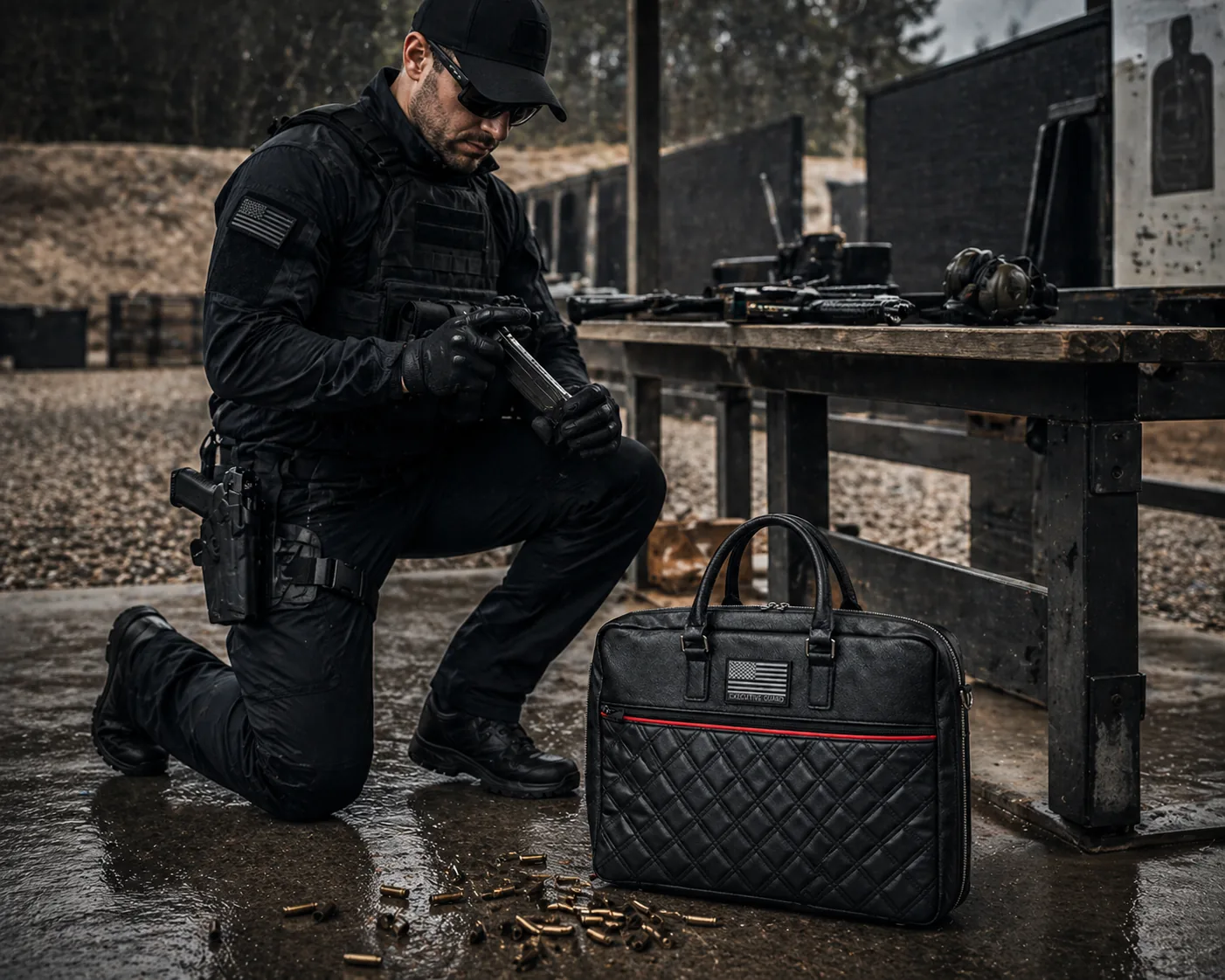
The REVIS-1 Executive Guard handles every cellular and wireless surveillance vector.

Three independently shielded chambers — laptop, tablet+phone, wallet+keys. 76–85 dB attenuation across 30 MHz – 10 GHz, covering 2G, 3G, LTE, 5G sub-6, 5G mmWave, plus WiFi, Bluetooth, GPS, NFC, RFID, and key-fob LF. Made in the United States. Used by journalists, attorneys, diplomats, and corporate-security teams as one layer in a defense-in-depth posture.

Acquire — $129 Privacy Pillar
FAQ

Common questions on IMSI-catcher protection.

What is an IMSI catcher?
An IMSI catcher is a portable cell-site simulator that mimics a legitimate cellular tower. Phones in range are tricked into connecting to it instead of a real tower. Once connected, the operator harvests the phone's IMSI (International Mobile Subscriber Identity), call metadata, SMS content, and approximate location. Stingray is the brand-name reference (Harris Corporation) but the term has become generic. Modern variants include Hailstorm, Triggerfish, and various international equivalents. Used legally by U.S. federal and state law enforcement under court order, and illegally by foreign intelligence services and corporate-espionage operators.
Are IMSI catchers used in the United States?
Yes — extensively. Federal law enforcement (FBI, DEA, U.S. Marshals, ICE-HSI), state and local police, and military intelligence all deploy IMSI catchers under various authorization frameworks. EFF and ACLU litigation has documented thousands of deployments since 2010. Separately, foreign intelligence services are believed to operate IMSI catchers near U.S. embassies, financial conferences, and high-value-target locations — though by their nature these deployments are not publicly documented. Civil libertarian researchers have detected unexplained cellular anomalies near major U.S. financial hubs and political events that strongly suggest non-domestic operators.
How does Faraday isolation defeat an IMSI catcher?
By removing the phone from the cellular network entirely. IMSI catchers require the target phone to attempt a cellular connection — that is when the simulator captures the IMSI and forces a downgrade to a less-secure protocol for further harvesting. Inside a quality Faraday bag (such as the REVIS-1 at 76–85 dB across 30 MHz – 10 GHz), the phone has no cellular signal whatsoever. There is nothing for the simulator to attach to. The attack cannot complete because the phone is not on any cellular network at all.
Can I detect if an IMSI catcher is operating near me?
Detection is difficult and unreliable. Apps like SnoopSnitch (Android) and AIMSICD attempt to detect cellular anomalies that suggest IMSI catcher activity, but modern simulators have countermeasures. Some signs that may indicate IMSI activity: unexplained 2G/3G downgrades when 4G/5G is normally available, unusually weak signal in areas with normally strong coverage, or the phone connecting to unfamiliar cell tower IDs. None of these are definitive. The operational answer is not detection but mitigation — Faraday isolation when you don't need cellular, and the assumption that you may be on a hostile network at any time when you do.
Who specifically should worry about IMSI catchers?
Five primary buyer profiles. Journalists working national-security, financial-investigation, or organized-crime beats. Attorneys handling material non-public M&A information or sensitive litigation. Diplomats and consular staff in or near embassies. C-suite executives at companies that are M&A targets or have access to material non-public information. Activists and dissidents from countries with active intelligence operations against their diaspora. The threat is not theoretical for any of these — documented cases exist for each category.
Will Airplane Mode protect me from an IMSI catcher?
Yes — IF Airplane Mode is fully active and you trust your phone's implementation. Airplane Mode disables cellular, WiFi, and Bluetooth at the OS level. The challenge is trust: a compromised phone may report Airplane Mode in the UI while continuing to transmit. Faraday isolation is mathematically guaranteed regardless of OS state — the radio cannot transmit because the conductive enclosure prevents it physically. For high-stakes scenarios (state-actor threat models, post-compromise device handling), Faraday is the trustworthy answer; Airplane Mode is convenient but software-dependent.
Does 5G stop IMSI catchers?
Partially, but not fully. 5G includes stronger encryption of the IMSI exchange that defeats some legacy IMSI catchers. However, modern 5G-capable simulators (NR-mode Stingrays, available since 2022) defeat the new protections. Additionally, IMSI catchers can force a phone to downgrade from 5G to LTE or 3G to bypass the protections. The structural answer is: 5G raises the bar but does not close the attack class. Faraday isolation closes the attack class entirely by preventing the phone from connecting to anything.
What's the right Faraday product for IMSI-catcher protection?
Any quality Faraday product rated for the full cellular spectrum (600 MHz – 6 GHz minimum, ideally extending to 10 GHz to cover 5G mmWave). For a phone-only use case, a single-chamber Faraday phone sleeve at $30–$80 is sufficient. For executives, journalists, attorneys, and HNW principals carrying multiple devices that all need protection (phone + laptop + tablet + key fob + RFID credentials), the REVIS-1 Executive Guard at $129 covers all of them in one structured briefcase. The choice depends on whether you need single-device or multi-device coverage.