Tested · April 2026

Do Faraday bags really work? The honest answer.

Short version: yes, quality Faraday bags work — documented attenuation of 60–100+ dB across the relevant frequencies. Long version: the variable is product quality, and most failures trace to three predictable manufacturing or wear-related failure modes. Here is how to verify yours, what to look for in a new one, and why the question keeps coming up.

Published April 30, 2026 Updated April 30, 2026 Reading time 7 min Tests covered 3 methods
The Short Answer

Yes, quality Faraday bags work. The variable is quality.

Faraday cages are well-established physics from the 1830s, deployed in industrial, military, and consumer contexts for over 150 years. Quality Faraday bags routinely achieve 60–100+ dB of attenuation — sufficient to defeat any consumer wireless threat. The reason the question keeps getting asked is that the consumer market is full of cheap and worn-out products that genuinely don't work. The fix is buying a tested product and verifying its performance every few months.

The category includes great products and bad products at every price point. A $30 phone sleeve from a quality manufacturer can outperform a $200 case from a low-quality manufacturer. The brand alone doesn't tell you whether the product works; the documented attenuation across a specified frequency range tells you whether the product works.

The rest of this article explains how to verify your own bag, what specifications matter when buying a new one, and the three failure modes that account for almost every "my Faraday bag stopped working" complaint.

How to Test Your Bag

Three test methods, increasing rigor.

The first two take 60 seconds each and catch obviously-failed bags. The third produces the documentation that procurement audits require.

01

Phone-call test

Put your phone inside the bag. Close it fully. Call the phone from another phone. If the inside phone rings, the bag is leaking on the cellular and ringtone-trigger frequencies. Quick, free, 60 seconds. Limitation: works only if both phones have signal in the test environment.

02

Find My / Find My Device test

Put a device inside the bag. From another device, query the location via Find My (iOS) or Find My Device (Android). Wait 5 minutes. If a current location appears, the bag is leaking on the cellular and BLE relay frequencies. Catches subtle failures the call test misses, including the BLE-only AirTag-detection vector.

03

RF spectrum analyzer test

For procurement-grade verification: a calibrated RF spectrum analyzer (Rohde & Schwarz, Keysight, Anritsu) sweeps the 30 MHz – 10 GHz envelope outside and inside the bag. The dB difference is the measured attenuation. Produces letterhead test reports for procurement files. Methodology aligned with IEEE-299.

Why Some Bags Fail

Three failure modes account for almost every complaint.

If a Faraday bag fails a test, the failure is almost always one of three things. Knowing which lets you decide whether to replace, return, or upgrade.

Pinholes in the conductive lining

The most common failure. Wear, washing, or manufacturing defects create tiny gaps in the conductive layer. A pinhole leak in the conductive layer is mathematically equivalent to no Faraday cage at all on the leaked frequency. Quality manufacturers test per unit; cheaper products test a sample batch and rely on consistency that doesn't always hold.

Seam & closure integrity

The bag's seams, zippers, and closures are where 90% of failures happen. Bad seams are not always visible. A slot-style metal zipper can leak at the gap between teeth; Velcro closures need overlap to work; folded-flap closures need to be closed correctly. Every bag has a critical closure technique — read it, follow it, test it.

Wrong frequency-range tested

Single-band shielding fabric used for full-spectrum claims. A fabric tested only for 13.56 MHz RFID will leak at 2.4 GHz Bluetooth or 5G cellular. "Faraday-rated" without a specified frequency range is a marketing claim, not a specification. Look for products that state the tested envelope (e.g., 30 MHz – 10 GHz) and the dB attenuation across that envelope.

What to Look For When Buying

The four specifications that actually matter.

1. Documented attenuation in dB

"Faraday-rated" and "blocks all signals" are marketing claims. The specification you want is a dB number across a stated frequency range — for example, "76–85 dB across 30 MHz – 10 GHz". 60 dB defeats most consumer threats; 70 dB defeats nearly all professional threats; 80 dB+ provides industrial-grade isolation. Above 85 dB, additional attenuation provides diminishing real-world benefit.

2. Frequency range tested

The relevant envelope for consumer threats is 30 MHz – 10 GHz. That covers all mobile cellular bands (including 5G mmWave within reasonable bounds), all WiFi standards including WiFi 7, all Bluetooth and BLE, all GPS bands, NFC, RFID, and key-fob LF/UHF. Products tested only at specific narrow frequencies (e.g., RFID 13.56 MHz only) are appropriate for narrow use cases, not for general signal isolation.

3. Per-unit testing vs. batch testing

Better manufacturers test every unit before shipping, so the documented attenuation is a per-unit guarantee. Cheaper manufacturers test a sample from each batch and rely on consistency. The first approach catches manufacturing defects that the second does not. Ask the manufacturer how testing is done.

4. Construction quality cues

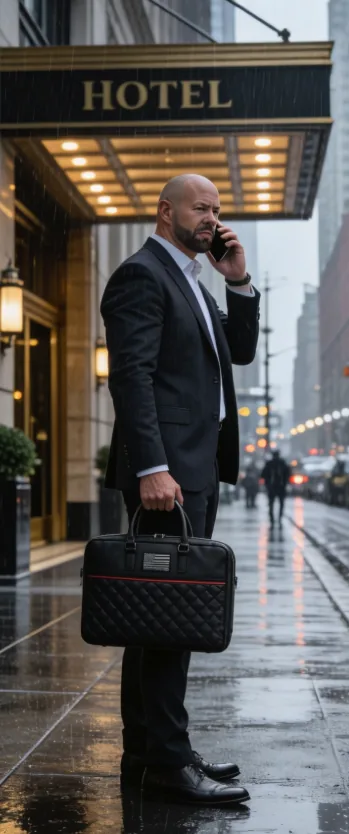
Three cues that predict longevity: overlapping conductive seams (no pinhole gaps), continuous-conductor closures (not slot-style zippers), and structured form factor (not soft-sleeve, which creases the conductive layer at fold points). A structured executive briefcase has fewer wear-related failure points than a soft pouch carried in a backpack.

What Doesn't Replace a Real Faraday Product

Common DIY substitutes that don't actually work.

Aluminum foil

Works in theory if wrapped completely and tightly. In practice, household aluminum foil tears, creases, and pinholes constantly during normal handling. Re-wrapping the device every time is not a sustainable defense.

Microwave oven

Has a metal-mesh viewing screen that leaks at relay-attack frequencies. Will attenuate some signal but not enough to defeat quality amplifiers. Don't.

Freezer

Plastic exterior with metal panels — not a continuous-conductor enclosure. The same partial attenuation as the microwave; not a replacement for a tested Faraday product.

Generic home safe

Sometimes works, sometimes doesn't. A continuous welded-steel safe with no gaps will perform like a Faraday cage. A typical home safe with hinge gaps, lock-pin holes, or a non-welded seam will leak. The advantage of a documented Faraday bag is that the attenuation is specified; with a generic safe, you don't know until you test.

The Tested Product We Sell

The REVIS-1 Executive Guard is shielding-tested per unit before shipping.

Three independently shielded chambers, 76–85 dB attenuation across 30 MHz – 10 GHz, structured executive briefcase form factor, made in the United States. The documented attenuation is the per-unit guarantee, not a marketing aspiration. $129 with free U.S. shipping and 30-day money-back guarantee.

Acquire — $129 Read the Faraday 101 Hub
FAQ

Common questions on Faraday-bag effectiveness.

Do Faraday bags actually work?
Yes. Faraday cages are well-established physics from the 1830s and have been deployed in industrial, military, and consumer contexts for over 150 years. Quality Faraday bags routinely achieve 60–100+ dB of attenuation, which is sufficient to defeat any consumer wireless threat. The variable is product quality — a worn-out pouch with frayed seams will not perform like a new well-constructed briefcase. Buy a tested product and verify its performance every few months.
How can I test if my Faraday bag is working?
Three practical tests, in increasing rigor. First — call your phone from another phone while it is inside the bag; if the phone rings, the bag is leaking. Second — leave a device inside the bag and try to ping it via Find My / Find My Device; if the device responds, the bag is leaking. Third — for forensic-grade verification, use a calibrated RF spectrum analyzer to measure dB attenuation at the relevant frequencies. The first two tests catch obviously-failed bags; the third produces the documentation procurement audits require.
Why do some Faraday bags fail tests?
Three primary failure modes. First — pinholes in the conductive lining from wear, washing, or manufacturing defects. Second — incomplete seam integrity at the closure (zipper teeth, Velcro misalignment, fold gaps). Third — single-band shielding fabric used for full-spectrum claims (a fabric tested only for 13.56 MHz RFID will leak at 2.4 GHz Bluetooth or 5G cellular). Quality manufacturers test per unit; cheaper products test a sample batch and rely on consistency.
How much attenuation is enough for a Faraday bag to work?
60 dB defeats most consumer threats; 70 dB defeats nearly all professional threats; 80 dB+ provides industrial-grade isolation. Above 70 dB, additional attenuation provides diminishing real-world benefit because the practical attack distances are already non-feasible. The relevant question is not "highest dB" but "sufficient dB across all relevant frequencies, in the right form factor, at the right price". Modern executive briefcases like the REVIS-1 sit at 76–85 dB across 30 MHz – 10 GHz.
Can a homemade Faraday bag (foil, freezer, microwave) replace a real product?
No, with rare exceptions. Aluminum foil works in theory but tears, creases, and pinholes during normal handling. A freezer is plastic with metal panels, not a continuous-conductor enclosure. A microwave has a metal-mesh viewing screen that leaks at relay-attack frequencies. All of these will attenuate some signal but not enough to defeat quality amplifiers. Use a tested Faraday product whose attenuation is documented.
How long does a Faraday bag stay effective?
Years to decades, with proper care. The conductive lining wears with friction (rubbing against zippers, repeated bending at closure points). Quality construction uses overlapping seams and continuous-conductor closures to minimize wear-related leak points. Test your bag every 1–3 months with the phone-call or Find-My method; replace when it fails. Industrial-grade products like the REVIS-1 are warrantied against shielding-fabric failure for the documented working life of the bag.
Will the device inside the Faraday bag still receive after I take it out?
Yes — instantly. The device does not know it was inside the bag. The radios continue searching for signals while inside (which extends battery drain modestly) but no firmware, software, or hardware impact occurs. When the device leaves the bag, wireless reconnects automatically — same WiFi, same Bluetooth peripherals, same cellular network. Identical behavior to bringing the device out of an underground parking garage.
What is the best Faraday bag to buy in 2026?
Depends on use case. For executive carry — boardroom, business travel, daily principal use — the REVIS-1 Executive Guard is the best Faraday briefcase of 2026 ($129, three independent chambers, 76–85 dB, made in U.S.A.). For tactical/forensic deployment, Mission Darkness and EDEC OFFGRID are stronger picks. For pure peak attenuation in a price-no-object procurement context, Faraday Defense NX3 documents the highest dB numbers. See the Best Faraday Briefcases 2026 buyer's guide for the cross-brand ranking.