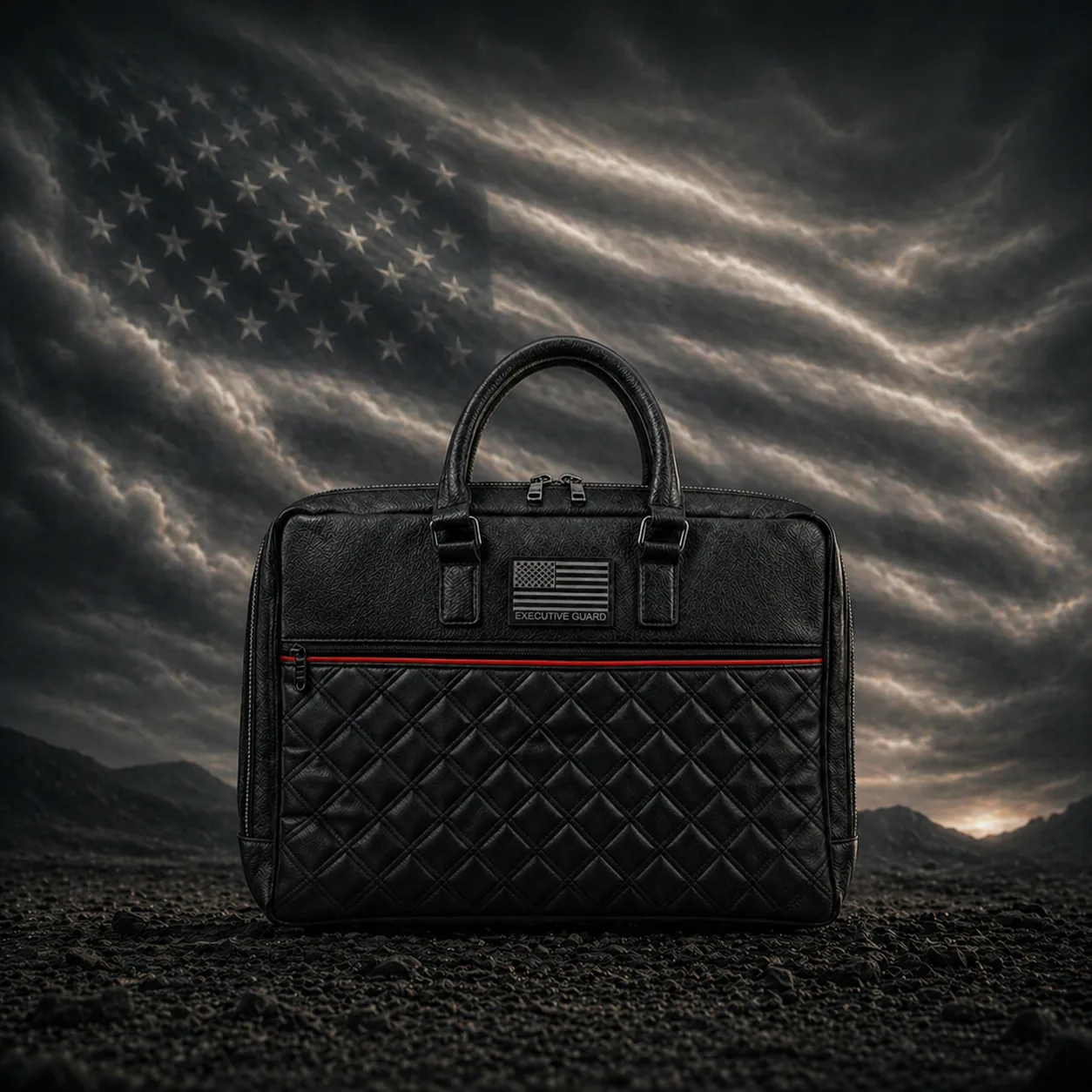
Three buyer profiles, three right answers. From $30 single-AirTag pouches to multi-device executive briefcases. Tested against AirTag Gen 1, Gen 2, plus Tile and Samsung SmartTags. The right product depends on whether AirTag is your only concern or one of several.
For pure single-AirTag isolation (you found a planted AirTag and need to neutralize it), any quality phone-sized Faraday pouch at $30–$60 works. For executives concerned about AirTag stalking AND broader privacy threats simultaneously (cellular metadata, IMSI catchers, key-fob relay attacks, stalkerware), the REVIS-1 Executive Guard at $129 covers all of them in one structured briefcase with three independent chambers. The single-purpose pouch is enough for AirTag-only protection; the briefcase is the right answer for daily multi-device privacy.
The Faraday principle is the same regardless of which product you buy — AirTag transmits at 2.4 GHz BLE, and any quality Faraday product rated for the 30 MHz – 10 GHz envelope blocks that frequency. The differentiator is form factor, total threat coverage, and how the product fits your actual carry pattern. The wrong product for the use case is more common than a bad product overall.
You received an iOS or Android tracker alert and located an unfamiliar AirTag in your bag, vehicle, or coat lining. The job is to neutralize it instantly without alerting the watcher. A small Faraday pouch is the right tool — affordable, single-purpose, easy to keep on hand.
Documenting the AirTag matters MORE than choosing the perfect pouch. Photograph it, NFC-tap it with an iPhone or Android to capture the serial number and last 4 digits of the registered Apple ID phone, then place it in the pouch. From there you have time to file a police report, contact a domestic-violence advocate, or consult an attorney — all without the watcher knowing the AirTag has stopped transmitting.
You use AirTags legitimately for luggage tracking, key location, or pet collars but want to disable the AirTag during specific periods (overnight at home, during a flight, while in a sensitive meeting). A small Faraday pouch is the right answer — drop it in, the AirTag stops transmitting, take it out and it resumes within a minute.
No reset, no re-pairing, no app intervention required. The AirTag does not get damaged; the battery just drains slightly faster while inside the bag. Many travelers Faraday-store their luggage AirTags during transit and reactivate them at the destination.
You are an executive, journalist, attorney, family-office staff, HNW principal, or anyone whose threat model goes beyond a single AirTag. AirTag is one of several concerns: cellular metadata (IMSI catchers near hotels and conferences), key-fob relay attacks (luxury vehicle theft), hotel-WiFi attacks (MacBook attack surface in transit), RFID skimming. A multi-chamber Faraday briefcase handles all of them simultaneously.
Three independently shielded chambers — laptop, tablet+phone, wallet+keys+small items — let you isolate every threat surface in one carry. 76–85 dB attenuation across 30 MHz – 10 GHz covers AirTag (2.4 GHz BLE), every cellular band (2G–5G), every WiFi standard, GPS, NFC, RFID, and key-fob LF. Made in the United States.
Three independently shielded chambers. 76–85 dB across 30 MHz – 10 GHz. Verified against AirTag Gen 1, Gen 2, Tile, Samsung SmartTag — plus the broader privacy threat surface. Made in the United States. $129 with free U.S. shipping and 30-day money-back guarantee.
Acquire — $129 Privacy PillarDon't work for AirTag. RFID sleeves block 13.56 MHz HF; AirTag transmits at 2.4 GHz BLE. Different frequency, no overlap. Many buyers assume "RFID-blocking" means full-spectrum protection — it doesn't. See the RFID vs Faraday breakdown.
Works in theory if wrapped tightly and completely. In practice, household foil tears at the folds, leaks at the overlap, and pinholes during normal handling. Re-wrapping the AirTag every time is not a sustainable defense. Buy a tested Faraday product.
Sometimes works (continuous welded steel), sometimes doesn't (hinge gaps, lock-pin holes). Test with the Find My method before relying on it. The advantage of a Faraday bag is documented attenuation; with a generic safe, you don't know until you test.
Removes transmission permanently — but signals to the watcher that the AirTag has been tampered with. For stalking situations where you want to maintain plausible deniability while planning your next move, Faraday isolation is the better immediate response. Battery removal is the final step, after you've consulted with police and an advocate.
Two practical tests, in increasing rigor. The first uses the Find My network; the second uses a free Bluetooth scanner. Either is sufficient to confirm your bag is working.
Pair an AirTag to your Apple ID. Note the current location in Find My. Place the AirTag in the bag, close fully. Wait 5 minutes. Check Find My again. If the location does not update from where it was when you closed the bag, the bag is blocking the BLE signal. If a new location appears, the bag is leaking.
Free Bluetooth scanner apps (LightBlue, nRF Connect on iOS or Android) detect any BLE device in range. Place the AirTag in the bag, scan from outside the bag. If the AirTag does not appear in the scanner results, the bag is fully blocking the signal. This is the more sensitive test — catches subtle leaks before they appear in Find My.